NHL 27 Controls Guide: Total Control vs Skill Stick
NHL 27 controls explained: Total Control button skill moves, Skill Stick right-stick dekes, and Hybrid, plus passing, one-timers, hitting, and goalie inputs.
Updated 2026-07-13
NHL 27 controls are built around three schemes that decide how you skate, shoot, deke, and defend: Total Control, Skill Stick, and Hybrid. The scheme sets whether skill moves come from face buttons or the right analog stick, and it does not lock you out of any action — every deke, pass, and check is reachable in all three, just mapped differently. New players usually start on Total Control, players who came from the series stay on Skill Stick, and Hybrid splits the difference.
This guide breaks down the NHL 27 controls for each scheme, then walks through the core actions you use every shift: deking, passing, one-timers, poke checks and stick lifts, body checking, and goalie play. Inputs are described by scheme and action rather than by fixed button glyphs, since mappings and any HUD prompts are confirmed at reveal. For the systems those inputs drive, see the gameplay overview, and for a first-game walkthrough read the beginner guide.
NHL 27 controls: the three schemes
The scheme picker lives in the settings menu and can be changed between games or mid-session. All three are expected to carry over from NHL 26, where they were the standard options across Franchise, Be A Pro, and World of Chel.
| Scheme | Skill moves | Best for | Trade-off |
|---|---|---|---|
| Total Control | Face buttons | Beginners, pad-shy players | Fewer simultaneous moves |
| Skill Stick | Right analog stick | Veterans, competitive play | Steeper learning curve |
| Hybrid | Mix of buttons and stick | Returning casual players | Some overlap to memorize |
Total Control maps dekes and dangles to single button presses, so you can trigger a move without rolling the stick — the fastest way to feel productive on day one. Skill Stick routes almost every move through the right stick: the direction and speed of your flick or roll shape the deke, giving you the full range of toe drags, between-the-legs moves, and lacrosse attempts, but it demands practice. Hybrid keeps shooting and deking on the stick while leaving a few actions on buttons, a comfortable step up from Total Control before you commit to full Skill Stick.
Skating and puck control
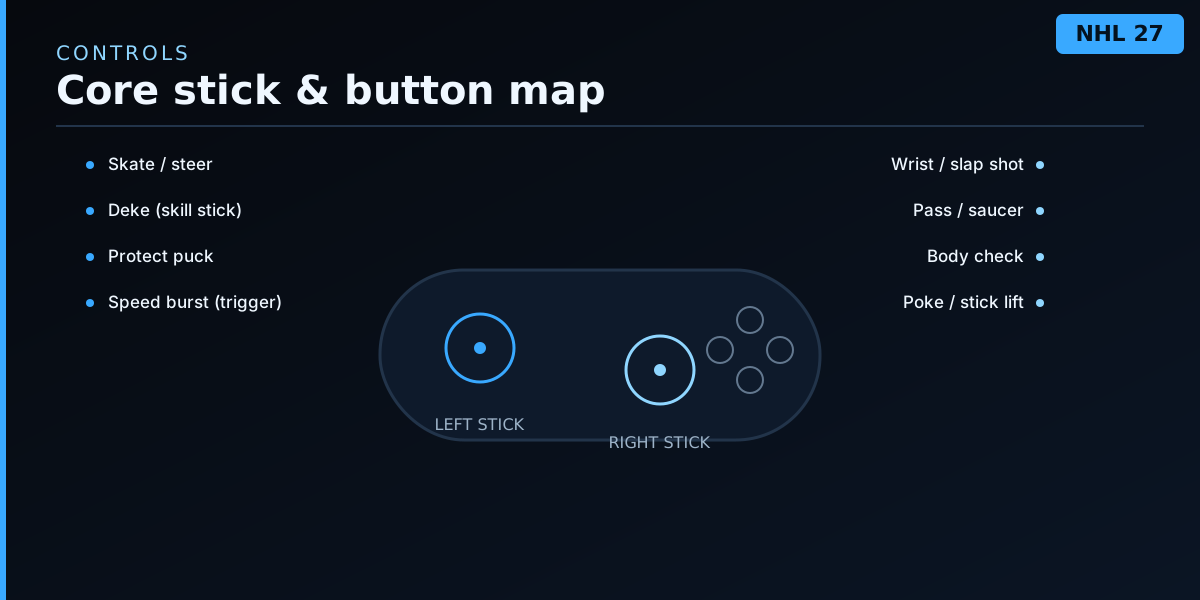
Skating is identical across all NHL 27 controls schemes: the left stick steers, and an acceleration input (a trigger or bumper depending on your layout) gives you an explosive burst that drains stamina. Feathering that burst instead of holding it keeps your endurance up for the third period. A separate protect-puck input shields the puck with your body, useful for cycling along the boards and absorbing contact without a turnover.
Puck control ties directly into your skater’s ratings — Puck Control, Agility, and Balance determine how tightly the puck stays on your stick through hard cuts. Use short, controlled skating rather than constant sprinting to keep options open. Backskating with a defenseman uses a modifier plus the left stick so you can face the rush while retreating, which is the foundation of good positional defense before you ever throw a check. Learning to glide on momentum — easing off the acceleration input between strides instead of holding it — also opens passing lanes that a constant sprint closes, and conserving that burst is what leaves you a step of jump for a late-period backcheck. It is the first habit that separates a controlled skater from a puck-chaser, and it costs you nothing to practice in a Play Now game.
Deking and dangles
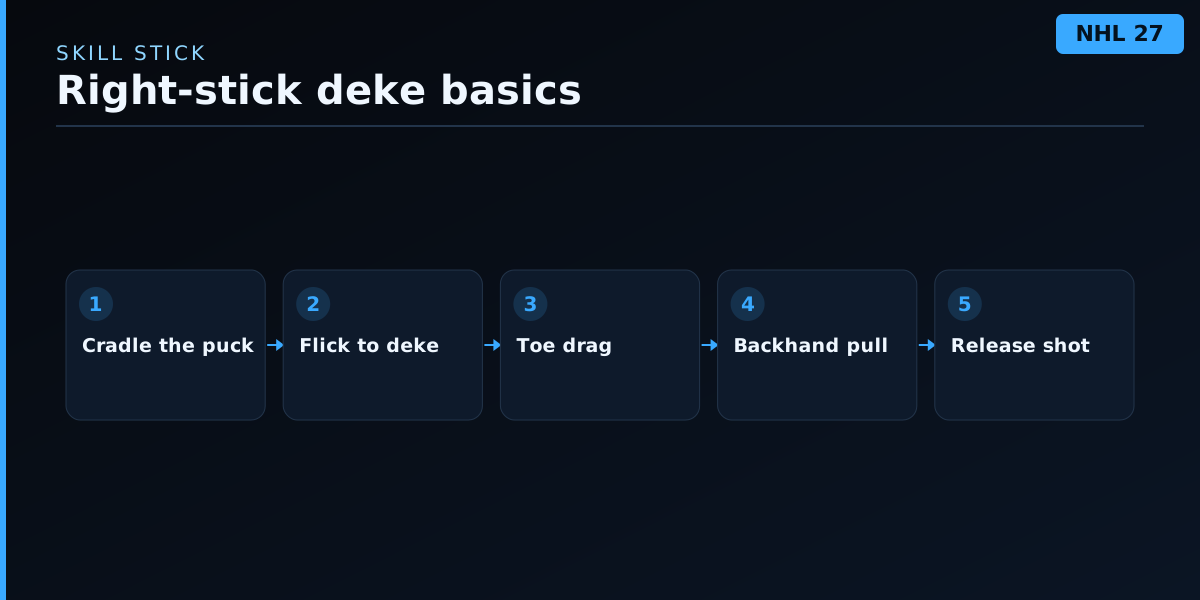
Deking is where the schemes diverge most. On Skill Stick, moves come from how you manipulate the right stick, so the same broad toolset is available with different flicks and rolls.
| Move | Skill Stick input (generic) | Notes |
|---|---|---|
| Toe drag | Right-stick pull toward the body | Backward and lateral variants supported |
| Between-the-legs | Right-stick roll through center | High-risk, high-reward in tight |
| Lacrosse (Michigan) | Right-stick scoop motion | Needs space behind the net |
| Fake shot into pass | Shot input canceled into a pass | Freezes the goalie and defenders |
The confirmed deking set includes toe drags with backward and lateral options, between-the-legs moves, the lacrosse pickup, and the fake-shot-into-pass. On Total Control, each of these maps to a button or button-plus-direction combo instead of a stick gesture, which is why beginners can pull off a clean toe drag on their first night. Deking success still depends on your Deking and Hand-Eye ratings, so a fourth-liner will not dangle like a top-line scorer. Start with the toe drag and the fake shot: they are the two highest-value moves at every skill level and translate cleanly across all three schemes.
Passing, shooting, and one-timers
Passing uses a single button whose hold length sets pass power — a tap for a short give-and-go, a longer hold to stretch the ice. Saucer passes lift the puck over sticks with a modifier, and the confirmed fake-shot-into-pass lets you sell a shot then dish across the slot. Shooting splits by scheme: Skill Stick shooting draws back and releases the right stick, with the pull-back distance shaping wrist versus slap shots, while Total Control keeps shots on a button so timing is simpler.
The one-timer is the highest-value shot in the game. Line up by having the passer feed you while you are already in a shooting motion: pre-load the shot (right-stick wind-up on Skill Stick, or hold the shot button on Total Control) before the puck arrives so your player fires in one fluid strike. Mistiming the wind-up produces a weak flub, so practice the rhythm in an empty net. Slap-shot one-timers carry the most power but need a longer wind-up window; wrist one-timers release faster and beat scrambling goalies.
Defense: poke, stick lift, and hitting
Defensive NHL 27 controls cover several confirmed tools. The poke check jabs the puck off an attacker’s stick but leaves you exposed if you miss; the stick lift pries the puck loose by lifting the opponent’s stick from underneath, a cleaner option in tight coverage. Board pins trap a puck carrier along the wall, and shot blocking drops your skater into the lane.
| Action | Purpose | Risk |
|---|---|---|
| Poke check | Knock puck off the stick | Penalty if you catch a leg |
| Stick lift | Lift the stick to steal | Beaten if you mistime |
| Body / hip check | Separate carrier from puck | Missed hit opens a lane |
| Shot block | Take away the lane | Deflections, injury risk |
Hitting is on the right stick: push into a carrier to deliver a body or hip check, and the confirmed reverse hit lets you check while skating away from the puck. Hip-check power scales with your turn angle, so a well-angled hit lands harder than a straight-line bump — but whiff and you are out of the play. Lean on positioning and the stick lift first; save big hits for carriers pinned to the boards.
Goalie controls
If you jump into net, goalie play uses the Crease Control System with over 80 save animations. The left stick moves the goalie’s positioning across the crease, and the right stick aims manual saves — glove, blocker, pad, and stacked saves respond to how you flick it. Automatic saves cover most shots, but manual control wins rebounds and breakaways by letting you steer where the puck ends up. Consecutive-save chaining rewards good positioning after the first stop, so recover square to the shooter rather than lunging. Depth matters too: challenging out at the top of the crease cuts the shooter’s angle but leaves you exposed to a cross-ice pass, while hugging the goal line gives you time to read a deke — reading which the situation calls for is the core skill of manual goaltending. Whichever of the NHL 27 controls schemes you run out of net, goalie mapping stays consistent, so a session in net is a low-pressure way to learn the game’s timing. For where these systems sit in the wider feature set, see everything we know about NHL 27.