NHL 27 Gameplay: ICE-Q, Deking, Checking & Goalies
NHL 27 gameplay is expected to build on NHL 26 with ICE-Q and NHL EDGE data, toe-drag deking, hip and reverse checks, and the goalie Crease Control System.
Updated 2026-07-13
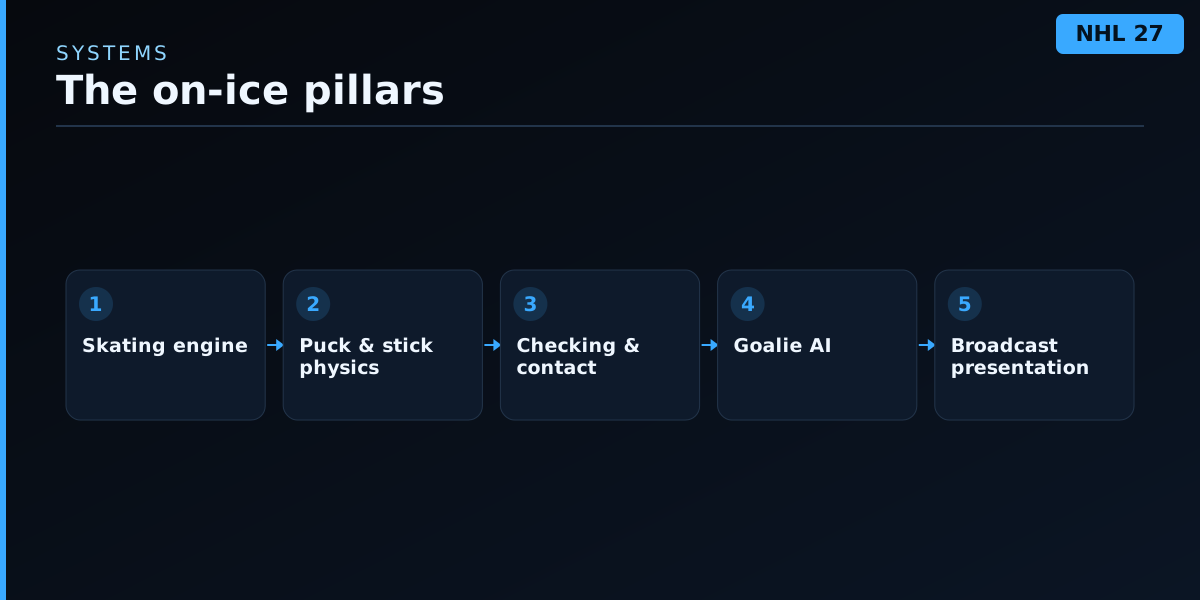
NHL 27 gameplay has not been detailed by EA — the reveal trailer is expected July 16, 2026 — so every system described here is drawn from NHL 26 and expected to return. NHL 26 launched in September 2025 on the ICE-Q 2.0 engine, which feeds real NHL EDGE tracking data into skating, positioning, and puck physics. Its pillars — three control schemes, a deep deking set, layered checking, and a rebuilt goalie save system — form the baseline any NHL 27 build starts from.
The sections below cover the engine, deking, checking, goaltending, and X-Factor abilities on PlayStation 5 and Xbox Series X|S.
NHL 27 gameplay foundations: ICE-Q and NHL EDGE
ICE-Q 2.0 is the engine behind NHL 26, and NHL 27 gameplay is expected to extend it rather than replace it. ICE-Q reads real-world NHL EDGE positional data — player location, speed, and skating paths tracked during actual games — and applies it to how skaters accelerate, hold lanes, and read plays away from the puck, so on-ice tendencies mirror real skating.
Input runs through three control schemes. Total Control maps skill moves to the face buttons and is the beginner path. Skill Stick puts most moves on the right stick and carries the highest ceiling. Hybrid blends button and stick inputs across separate offense and defense layouts. How well any move lands is bounded by a player’s ratings — Acceleration, Agility, Puck Control, and Deking among the roughly 25 skater attributes. The controls breakdown covers each scheme input by input. A rumored ICE-Q 3.0 has circulated ahead of reveal but remains unannounced.
Deking: toe drags, lacrosse, and fake-shot passes
Deking is the offensive core of NHL 27 gameplay, and NHL 26 already runs one of the deepest move sets in the series. Toe drags pull the puck across the body, and NHL 26 added them while a skater moves backward or laterally, opening deception in traffic rather than only on a straight rush. Between-the-legs moves and lacrosse-style lifts remain for close-quarters finishing.
A fake-shot animation lets a player wind up and then pass directly out of the deception, punishing defenders who commit to a block. Each move runs on the Skill Stick, with Total Control offering button-triggered equivalents for newer players. Success scales with the Deking, Puck Control, and Hand-Eye ratings, so an elite winger chains moves a fourth-liner cannot land. Expect this deking layer to carry into NHL 27 with the same stick-based inputs.
Checking: body, hip, and reverse hits
Defense in NHL 27 gameplay is built from a stack of contact tools. Body checks are the base hit; hip checks drop low to upend a puck carrier; and reverse hits let a defender absorb and redirect an oncoming skater. NHL 26 scaled hip-check power to turn angle — the sharper the angle into the hit, the more force it carries — and rebalanced reverse hits to favor larger players, so a 220-pound defenseman wins collisions a smaller one loses.
Away from open-ice contact, the toolkit adds the poke check, the stick lift, board pins along the wall, and the shot block to eat a shot in the lane. These read against the Body Checking, Strength, Checking, Stick Checking, and Shot Blocking attributes, so contact outcomes are rating-driven rather than random, with Discipline governing penalty risk on a late or high hit. This checking model is expected to return intact in NHL 27.
Goalie Crease Control System
Goaltending runs on the Crease Control System, which NHL 26 backs with more than 80 save animations. A consecutive-saves mechanic rewards a goalie for stacking stops in a scramble, and positioning varies by goalie size and style, so a tall butterfly netminder covers the net differently than a smaller, reactive one. The system pulls from goalie-specific attributes — Glove High and Low, 5-Hole, Stick High and Low, Shot Recovery, Positioning, Breakaway, Vision, Poke Check, and Rebound Control.
Those roughly 11 ratings decide whether a rebound kicks to the slot or gets smothered, and whether a breakaway deke beats the glove. A cross-crease pass forces a lateral push-off, where Positioning and Shot Recovery decide if the goalie squares to the shooter in time. On defense, the controls let you take manual control of the goalie or leave positioning to the CPU. NHL 27 gameplay is expected to keep the Crease Control System as the goalie foundation.
NHL 27 X-Factors and Superstar abilities
X-Factors, also called Superstar Abilities, are signature perks that unlock elite behaviors when in-game conditions are met, flagged by on-screen trigger cues. NHL 26 carried 28 of them across five categories — Offensive, Defensive, Playmaker, Goalie, and a top-tier impactful group — organized into three tiers of strength. A sniper’s shooting X-Factor sharpens accuracy on a one-timer; a defensive ability tightens gap control or shot blocking.
In World of Chel, loadouts run these abilities class-free across three slots, so a created player mixes offensive and defensive perks without being locked to an archetype. Across the rest of the modes, X-Factors attach to real NHL stars based on their ratings, making elite players play like their real counterparts. This ability system is expected to return in NHL 27, with any new or retired abilities revealed alongside the roster.